



Short Overview
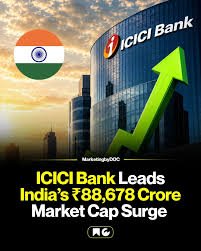
Six of India’s top 10 most-valued companies added ₹88,678 crore in market capitalization during a positive trading week. ICICI Bank became the biggest gainer, followed by HDFC Bank, Reliance Industries, Bajaj Finance, State Bank of India and Larsen & Toubro. This movement shows how investor confidence can quickly shift toward large, trusted companies when market sentiment improves.
ICICI Bank market cap gain became the biggest highlight as six of India’s top 10 valued companies added ₹88,678 crore in market value. The rise came during a positive week for Indian equities, supported by gains in banking, finance, infrastructure and large-cap stocks. This blog explains what happened, why ICICI Bank led the rally, which companies gained, which firms lost value, and what investors can understand from this movement in simple language.
What Happened in the Indian Stock Market?
The Indian stock market saw a positive move as six of the country’s top 10 most-valued companies added a combined ₹88,678 crore in market value. This was an important weekly movement because it came from large and trusted companies that usually influence investor sentiment across the market.
ICICI Bank became the biggest gainer among these companies. Its market capitalization increased by ₹29,588.75 crore, taking its total valuation close to ₹9.96 lakh crore. This made ICICI Bank the strongest performer among India’s most valuable companies for the week.
The overall market also ended in positive territory. The BSE Sensex moved higher by 297.57 points, while the NSE Nifty also posted a weekly gain. These numbers may look small compared to daily stock movements, but they are important because they show that the broader market remained stable and positive during the week.
The gain was not limited to one company. Reliance Industries, HDFC Bank, ICICI Bank, State Bank of India, Bajaj Finance and Larsen & Toubro all saw an increase in market value. This shows that investors were not only buying banking stocks, but were also showing interest in finance, infrastructure and large-cap companies.
At the same time, not every company gained. Bharti Airtel, Tata Consultancy Services, Life Insurance Corporation of India and Hindustan Unilever saw a fall in their market capitalization. This is normal in the stock market because money keeps rotating from one sector to another depending on news, valuation, earnings expectations and investor confidence.
Why ICICI Bank Became the Biggest Gainer
ICICI Bank’s market cap gain became the biggest highlight because the bank added the highest value among the top 10 companies. When a large private bank adds nearly ₹29,589 crore in valuation in a short period, it sends a strong message to the market.
The reason behind this move can be linked to investor confidence in banking stocks. Private sector banks like ICICI Bank are closely watched by institutional investors, mutual funds, foreign investors and retail investors. When the market believes that banking stocks can deliver steady earnings, good asset quality and strong loan growth, these stocks usually attract buying interest.
ICICI Bank has been one of the most closely tracked banking stocks in India. Investors generally follow its loan growth, deposit growth, net interest margin, asset quality and profitability. When market sentiment is positive, strong banks often become the first choice for investors because they are seen as stable large-cap businesses.
Another reason is the importance of banking in the Indian economy. Banks are connected to almost every major part of economic growth. When businesses borrow, consumers take loans, people use credit cards, companies expand and infrastructure spending increases, banks become direct beneficiaries. This makes banking stocks important for long-term market direction.
ICICI Bank’s gain also matters because it brought the bank closer to the ₹10 lakh crore market capitalization mark. This level is psychologically important for investors because companies with such high valuations are seen as market leaders. Crossing or moving close to such valuation zones often attracts more attention from analysts and investors.
What Market Capitalization Means in Simple Words
Market capitalization, also called market cap, is the total value of a company in the stock market. It is calculated by multiplying the company’s share price by the total number of shares.
For example, if a company has 100 crore shares and each share trades at ₹500, the company’s market capitalization becomes ₹50,000 crore. This value changes every trading day because share prices move up and down.
Market cap does not mean the company has that much cash in the bank. It simply shows what the stock market currently thinks the company is worth. When investors buy more shares and the price goes up, the market cap increases. When investors sell shares and the price falls, the market cap decreases.
This is why large companies can gain or lose thousands of crores in market value within a week. The company itself may not have changed dramatically in seven days, but investor perception, demand for the stock and market sentiment can change quickly.
Market cap is important because it helps investors understand the size of a company. Large-cap companies are usually well-established businesses with strong market presence. Mid-cap companies are smaller than large caps but may offer faster growth. Small-cap companies can grow faster but usually carry higher risk.
In this case, the movement happened among India’s top 10 most-valued companies. These are not small or unknown businesses. They are market leaders from banking, telecom, technology, energy, finance, infrastructure, insurance and FMCG sectors. That is why their market cap movement matters for the entire stock market.
Six Companies That Added Market Value
The six companies that gained market value were ICICI Bank, HDFC Bank, Reliance Industries, Bajaj Finance, State Bank of India and Larsen & Toubro. Each of these companies belongs to an important sector of the Indian economy.
ICICI Bank added the highest value and became the biggest gainer. Its valuation rose by ₹29,588.75 crore, taking its market capitalization to around ₹9,95,610 crore. This showed strong investor interest in the private banking space.
HDFC Bank also posted a strong gain. Its market capitalization increased by ₹24,718.3 crore and reached around ₹12,25,981 crore. HDFC Bank remains one of India’s most important financial stocks because of its large customer base, strong branch network and major role in banking services.
Reliance Industries added ₹12,043.96 crore in market value. Its total valuation stood around ₹17,83,926 crore, making it India’s most-valued company. Reliance is important because it has business interests across energy, telecom, retail and digital services. Any movement in Reliance shares can influence the broader market.
Bajaj Finance gained ₹11,580.28 crore in market capitalization. Its valuation rose to around ₹6,10,081 crore. Bajaj Finance is a major non-banking finance company and is closely followed because of its consumer lending business, digital finance presence and growth profile.
State Bank of India added ₹9,322.93 crore to its valuation, taking its market cap to around ₹9,64,738 crore. SBI is India’s largest public sector bank and plays a major role in lending, deposits and financial inclusion. When SBI gains, it often reflects confidence in the public sector banking space.
Larsen & Toubro also gained value, though its increase was smaller compared to the banks and finance companies. Its market capitalization rose by ₹1,423.88 crore to around ₹5,80,550 crore. L&T is a major infrastructure and engineering company, so its movement is often linked to capital expenditure, construction, government spending and industrial growth.
Together, these six companies added ₹88,678 crore in value. This number shows that investors preferred strong, established and widely tracked companies during the week.
Companies That Lost Market Value
While six companies gained, four companies from the top 10 list lost market value. These companies were Bharti Airtel, Tata Consultancy Services, Life Insurance Corporation of India and Hindustan Unilever.
Bharti Airtel saw the biggest fall among the laggards. Its market capitalization declined by ₹35,615.21 crore. Even though Bharti Airtel remains one of India’s strongest telecom companies, its stock saw selling pressure during the week.
LIC also lost market value. Its valuation fell by ₹21,188.74 crore. Insurance companies can move based on investor expectations around premium growth, profitability, policy changes and market-linked investment performance.
Tata Consultancy Services lost ₹11,143.71 crore in market value. TCS is India’s leading IT services company and one of the country’s most valuable businesses. IT stocks often react to global demand, currency movements, client spending and expectations from the US and European markets.
Hindustan Unilever saw its market capitalization decline by ₹5,321.83 crore. HUL is one of India’s largest FMCG companies, but consumer stocks can face pressure when investors rotate money toward banks, infrastructure or other sectors with stronger short-term momentum.
These declines do not mean these companies are weak. Market cap can fall even in strong companies because stock prices move daily. Investors may book profits, shift money into other sectors or wait for clearer earnings growth. In the stock market, short-term valuation changes are common.
Why Banking Stocks Stayed Strong
Banking stocks were clearly among the strongest performers in this market movement. ICICI Bank, HDFC Bank and State Bank of India all added market value. This shows that investors had confidence in the banking sector during the week.
Banks usually perform well when investors expect stable credit growth, healthy deposit trends and controlled bad loans. A strong banking sector also supports the broader economy because banks provide loans to individuals, businesses and large companies.
Private banks like ICICI Bank and HDFC Bank attract attention because they have strong retail franchises, digital banking services and large balance sheets. Public sector banks like SBI attract interest when investors believe that government-backed banks can benefit from credit growth and improving asset quality.
The banking sector also carries heavy weight in Indian indices. This means that when major banks move higher, the Sensex and Nifty often receive support. For this reason, investors and analysts closely track banking stocks to understand the direction of the broader market.
Another reason banking stocks remain important is their connection with interest rates. When interest rates, liquidity and credit demand are favorable, banks can benefit. However, investors must also watch risks such as rising non-performing assets, pressure on margins and slower loan growth.
For retail investors, the key lesson is simple. Banking stocks can be powerful wealth creators, but they must be studied carefully. A rise in market cap is useful information, but it should not be the only reason to buy a stock.
What This Means for Retail Investors
This market movement gives an important lesson to retail investors. Large-cap stocks can create big changes in market value even with small percentage moves. When a company is already worth several lakh crore rupees, even a small rise in share price can add thousands of crores to its market capitalization.
For example, ICICI Bank’s strong market cap gain does not mean the stock doubled or tripled. It simply means the company is already very large, and a positive move in its share price created a big increase in total market value.
Retail investors should understand this difference. Market cap gain is useful for understanding investor interest, but it should not be treated as a direct buy signal. Before investing, it is important to check company fundamentals, valuation, earnings growth, sector outlook and personal risk capacity.
A common mistake many new investors make is chasing stocks after reading headlines. A headline saying that a company added thousands of crores in market value can look exciting. But by the time the news becomes popular, the stock may already have moved. Buying only because of a headline can lead to poor decisions.
Instead, investors should use such news to study the market. They can ask simple questions. Why did the stock rise? Is the company’s business improving? Are earnings expected to grow? Is valuation reasonable? Is the stock suitable for long-term holding? These questions help investors make better decisions.
This movement also shows the importance of diversification. Some companies gained while others lost value. A portfolio that depends only on one sector can become risky. A balanced portfolio across banking, technology, FMCG, energy, infrastructure and other sectors can handle market rotation better.
How Large-Cap Companies Influence Sensex and Nifty
Large-cap companies play a major role in Sensex and Nifty movement. These indices are designed to reflect the performance of leading companies in the Indian stock market. When the biggest companies move, the indices also react.
Reliance Industries, HDFC Bank, ICICI Bank, Bharti Airtel, SBI and TCS are among the most closely watched stocks in India. Their share price movement can influence investor mood because these companies are seen as indicators of India’s corporate strength.
When banks rise, it can support the Nifty Bank index and also help the Nifty 50. When Reliance moves higher, the overall market often receives support because of its large weight. When IT stocks such as TCS fall, the technology sector can come under pressure.
This is why market cap movements of top companies receive so much attention. They help investors understand where money is flowing. In this week’s movement, money seemed to favor banking, finance, energy and infrastructure more than telecom, IT, insurance and FMCG.
Large-cap companies also attract foreign institutional investors and domestic mutual funds. These investors usually prefer liquid and established stocks where they can invest large amounts without difficulty. This makes top companies more sensitive to institutional buying and selling.
For ordinary investors, tracking large-cap movements is useful because it gives a clear view of market leadership. If only a few stocks are rising while the rest of the market is weak, the rally may not be broad. But if multiple strong companies rise together, it can show healthier sentiment.

Should Investors Chase Market Cap Gainers?
Investors should not blindly chase market cap gainers. A rising market cap shows that investors are buying the stock, but it does not automatically mean the stock is undervalued or safe.
Before buying any stock, investors should check the company’s financial performance. Revenue growth, profit growth, debt level, cash flow, return ratios and management quality are important. For banks, investors should also check asset quality, loan growth, net interest margin and deposit growth.
Valuation is equally important. A good company can become a poor investment if bought at a very expensive price. A stock may rise because of short-term optimism, but future returns depend on how much growth is already priced in.
Investors should also look at their own goals. A long-term investor may study ICICI Bank, HDFC Bank or SBI differently from a short-term trader. A trader may focus on momentum, price action and support levels. A long-term investor should focus more on business strength and valuation comfort.
It is also important to avoid emotional investing. Headlines about thousands of crores being added to market value can create fear of missing out. But the stock market always gives new opportunities. A patient investor does not need to enter every rally.
The better approach is to create a watchlist. Investors can track top market cap gainers, study their quarterly results, compare valuations and wait for better entry levels. This reduces emotional decision-making and improves investment discipline.
Key Takeaways from the Market Movement
The biggest takeaway is that India’s large-cap space remained active and positive during the week. Six of the top 10 valued companies added a combined ₹88,678 crore, showing that investor confidence was visible in select market leaders.
ICICI Bank stood out as the biggest gainer. This reflects strong interest in private banking stocks and shows how important banks remain for the Indian equity market.
HDFC Bank and SBI also gained, making banking one of the strongest themes of the week. Reliance Industries maintained its position as India’s most-valued company, showing that it continues to remain a central stock in the Indian market.
At the same time, the fall in Bharti Airtel, TCS, LIC and Hindustan Unilever shows that market gains are never equally distributed. Some sectors can rise while others fall. This rotation is a natural part of equity markets.
For investors, the message is clear. Market cap gain is a useful signal, but it should be studied with fundamentals. Strong companies can become stronger, but entry price and investment horizon matter.
The week also showed that Sensex and Nifty can remain positive even when some top companies fall. This happens when gains in certain heavyweights are strong enough to balance weakness in others.
Conclusion
The ICICI Bank market cap gain became the main highlight of the week as six of India’s top 10 companies added ₹88,678 crore in combined market value. The rise showed renewed investor confidence in banking, finance, energy and infrastructure stocks.
ICICI Bank led the gainers with a strong increase in valuation, while HDFC Bank, Reliance Industries, Bajaj Finance, State Bank of India and Larsen & Toubro also added value. On the other side, Bharti Airtel, TCS, LIC and Hindustan Unilever saw a decline in market capitalization.
For investors, this movement is important because it shows where market confidence was building. However, it should not be treated as a direct buying recommendation. Market cap changes are useful for understanding market mood, but smart investing requires deeper research.
A good investor looks beyond headlines. They study business quality, earnings growth, valuation, sector outlook and risk. The latest movement in India’s top companies is a reminder that large-cap stocks can drive market direction, but disciplined decision-making remains the real key to long-term wealth creation.