


Short Overview
The Tata Tiago 2026 facelift gives one of India’s best-known entry-level hatchbacks a much-needed modern makeover. Tata Motors has refreshed the exterior, redesigned the cabin, added stronger safety equipment and introduced several features usually associated with more expensive cars. With an introductory starting price of ₹4.69 lakh, petrol, iCNG and electric choices, the new Tiago aims to remain practical for first-time buyers while offering a more premium ownership experience.
the Tata Tiago 2026 facelift price, variants, features, safety upgrades, interior changes and engine options in this complete buyer-friendly guide. The refreshed Tiago starts at an introductory ₹4.69 lakh ex-showroom and brings six airbags as standard, a 10.25-inch touchscreen, digital driver display, rear AC vents, wireless charging, cruise control and an available 360-degree camera. Learn what is new in the exterior, how the petrol and iCNG versions compare, which variant may suit your budget, and whether this modern hatchback is worth considering against popular rivals.
Buying an affordable car no longer means accepting a plain cabin, limited safety equipment or outdated technology. Indian buyers now expect their first car to look stylish, feel comfortable and provide the features they use every day. The Tata Tiago 2026 facelift has been developed around these changing expectations.Tata Motors introduced the updated model on May 28, 2026, under the “Next Gen Tiago” name. It continues the Tiago’s decade-long journey in India while bringing one of the biggest design and cabin updates the hatchback has received. Tata says the Tiago family has already served more than seven lakh customers, giving the new model a strong foundation in the market.
The updated car is not simply an older Tiago with a different bumper. It receives a more upright exterior, a redesigned dashboard, larger digital displays, improved comfort features and stronger standard safety equipment. Petrol, iCNG and electric powertrains also allow buyers to choose a version that matches their daily travel and ownership budget.
Tata Tiago 2026 Price and Variants
The Tata Tiago 2026 price begins at an introductory ₹4.69 lakh ex-showroom for the Smart petrol manual variant. The iCNG range starts at ₹5.79 lakh, while automatic options are available on several higher variants. Prices vary according to the selected fuel, transmission, location and trim.
The Smart petrol manual was introduced at ₹4.69 lakh, while the Smart CNG manual was listed at ₹5.79 lakh. The Pure range started at ₹5.49 lakh for the petrol manual, ₹6 lakh for the petrol AMT, ₹6.49 lakh for the CNG manual and ₹7.05 lakh for the CNG AMT.
The Pure+ range was announced from ₹5.99 lakh for petrol manual buyers. Its petrol AMT, CNG manual and CNG AMT versions were priced at ₹6.55 lakh, ₹6.99 lakh and ₹7.55 lakh respectively. The Creative range began at ₹6.99 lakh, while the better-equipped Creative+ petrol manual was introduced at ₹7.29 lakh. These were launch prices, so customers should confirm the latest city-specific quotation before booking.
This wide selection is one of the Tiago’s strongest advantages. A buyer looking for a basic city car can choose an affordable manual, while someone dealing with daily congestion can move to an AMT. Buyers focused on lower fuel costs can consider iCNG without giving up the convenience of an automatic transmission.
A Sharper and More Confident Exterior
The previous Tiago had a rounded and friendly appearance. The 2026 model looks more upright, sharper and visually wider. Its flatter front design gives the car a stronger road presence without making it appear oversized for city use.
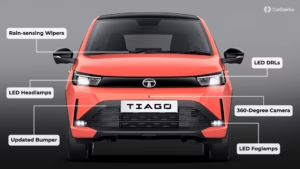
The updated front section receives sharper lighting elements, a slimmer grille and eyebrow-style daytime running lights. The bumper design is cleaner and more modern, helping the Tiago look closer to Tata’s latest passenger vehicles.
Higher variants receive attractive dual-tone alloy wheels, while black cladding around the wheel arches creates a slightly more rugged character. At the back, revised LED lighting and a cleaner bumper design make the hatchback look more contemporary.
The redesign is significant enough to make the new model easy to recognise, but the Tiago remains compact and suitable for crowded roads and tight parking spaces. Official specifications list a length of 3,813 mm, a width of 1,684 mm, a height of 1,535 mm and a wheelbase of 2,400 mm.
Tata Tiago 2026 Interior and Technology
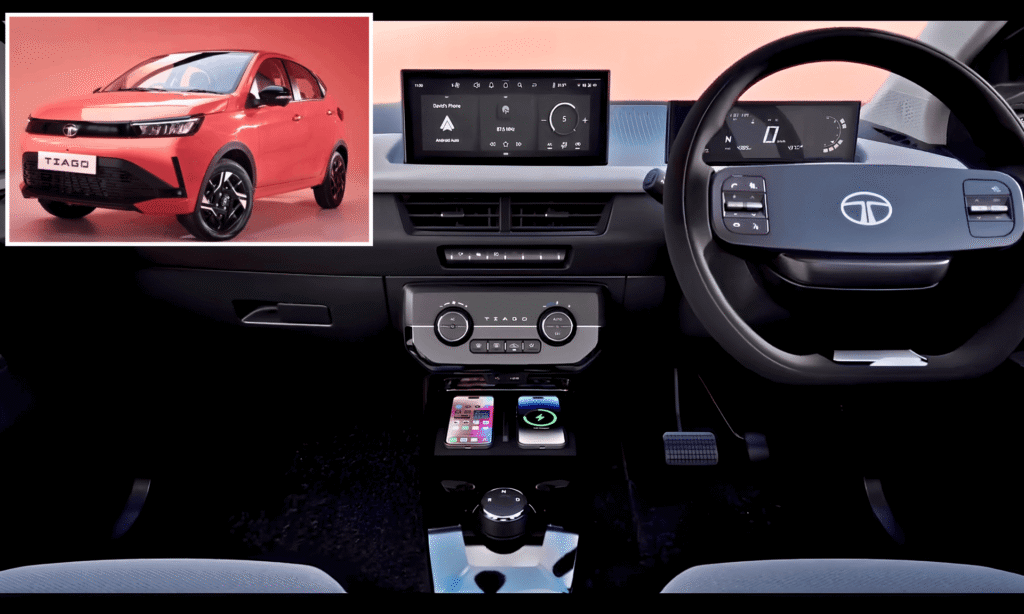
The most noticeable transformation is inside the cabin. The older dashboard has been replaced by a flatter and more horizontal design that makes the interior appear wider and less cluttered.
A freestanding 10.25-inch touchscreen becomes the visual centre of the dashboard on applicable variants. It supports wireless Apple CarPlay and Android Auto, allowing drivers to connect navigation, calls, music and supported mobile applications without repeatedly plugging in a cable. A separate digital instrument display presents essential driving information more clearly.
The new two-spoke steering wheel carries an illuminated Tata logo, adding a premium visual detail. Depending on the selected variant, buyers can also get wireless phone charging, cruise control, rear AC vents, a cooled glovebox, a front armrest with storage and a four-speaker audio system.
AMT versions use a modern rotary gear selector instead of a conventional gear lever. This makes the centre console look cleaner and creates a stronger sense of occasion each time the driver starts the car.
These additions are not included in every variant, so buyers should compare the feature list carefully instead of selecting a model only by price. Nevertheless, the availability of this technology shows how far affordable hatchbacks have progressed.
Stronger Tata Tiago 2026 Safety Features
Safety is one of the biggest reasons to consider the refreshed Tiago. The new range receives six airbags as standard, including front, side and curtain protection. This is an important improvement because buyers no longer need to select only an expensive top variant to get a complete airbag package.
Electronic Stability Control and traction control help the driver maintain control when the vehicle detects a loss of grip. Parking sensors assist during low-speed manoeuvres, while selected variants offer a 360-degree camera and blind-view monitoring.
A 360-degree camera is particularly useful in crowded parking areas, narrow residential lanes and busy urban environments. It gives the driver a wider view of nearby obstacles that may not be visible through the mirrors.
The iCNG version also includes fuel-specific protection such as leak detection, thermal incident protection and a microswitch safety system. These features are designed to make CNG operation safer and more convenient.
Petrol Engine and Driving Performance
The new design does not bring a completely new petrol engine. The Tiago continues with Tata’s familiar 1.2-litre, three-cylinder naturally aspirated Revotron engine.
In petrol form, it produces approximately 86 PS and 113 Nm of torque. Buyers can pair it with a five-speed manual gearbox or a five-speed AMT. The manual version suits drivers who prefer greater control and a lower purchase price, while the AMT is easier to use in slow-moving city traffic.
This engine is designed mainly for practical urban driving rather than aggressive performance. It should feel comfortable during routine office commutes, school runs, shopping trips and occasional highway journeys.
Fuel efficiency will depend on the transmission, traffic, driving style, tyre pressure, load and use of air conditioning. Buyers should therefore treat laboratory mileage figures as a comparison tool rather than a guarantee of everyday fuel economy.
A proper test drive remains essential. It allows buyers to understand the three-cylinder engine’s sound, low-speed response, AMT behaviour, seating comfort and visibility before making a final decision.
Tata Tiago iCNG Automatic: A Practical Alternative
The Tiago iCNG uses the same 1.2-litre engine but produces approximately 75.5 PS and 96.5 Nm while running on CNG. It is available with both manual and AMT transmissions, making it attractive to drivers who want lower running costs without dealing with a clutch in traffic.
Tata’s twin-cylinder CNG arrangement is intended to preserve more usable luggage space than a conventional single-cylinder installation. The official specification lists a 60-litre water-capacity CNG system along with a 35-litre petrol tank.
The vehicle can start directly in CNG mode, reducing unnecessary petrol use during routine operation. Selected iCNG AMT variants also receive paddle shifters. Although buyers should not expect sports-car performance, the paddles offer greater control during overtaking or when a quick gear change is required.
For drivers covering long daily distances in areas with reliable CNG availability, this version could deliver a useful balance between convenience and operating cost.
What About the Tata Tiago EV?
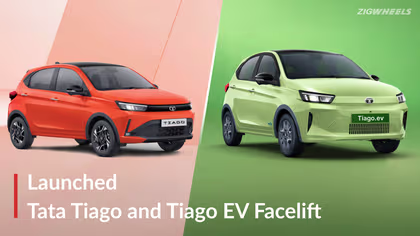
Tata Motors launched the next-generation Tiago EV alongside the petrol and iCNG models. At the May 2026 launch, the electric version was announced from ₹6.99 lakh under full ownership. A Battery-as-a-Service option was also introduced at ₹4.69 lakh plus a battery payment of ₹2.60 per kilometre. Prices and finance structures can change, so current terms should be confirmed through Tata’s official website or a dealership.
The EV is worth considering for owners who have dependable charging access and complete most of their travel within a predictable daily route. Petrol or CNG may remain more convenient for drivers who frequently travel long distances through areas with limited charging infrastructure.
Comfort and Everyday Practicality
A good city hatchback must be easy to enter, simple to park and comfortable enough for everyday family use. The Tiago’s compact dimensions support urban driving, while the 2,400 mm wheelbase provides a reasonable foundation for passenger space.
Rear AC vents are a valuable addition in India’s warm climate. The digital displays, wireless charging and smartphone connectivity also solve common daily inconveniences instead of functioning only as showroom attractions.
The petrol version offers a claimed 242-litre boot, which should be useful for grocery bags, office luggage or a short family trip. The available space must still be inspected personally if buyers regularly carry large suitcases, a baby stroller or bulky equipment.
Customers should also check rear-seat headroom, legroom and shoulder room with all regular passengers present. A specification sheet cannot fully explain whether a car feels comfortable for a particular family.
Which Tata Tiago Variant Should You Buy?
The Smart variant is suited to price-sensitive buyers who want the core Tiago experience and standard safety equipment. It can work well as a first car, a second family vehicle or a straightforward city commuter.
The Pure and Pure+ variants are likely to provide a more balanced mix of price, convenience and technology. They deserve attention from buyers who want useful daily equipment without stretching to the highest trim.
The Creative and Creative+ variants target customers who value the larger touchscreen, upgraded styling and premium convenience features. These versions cost more, but they also create the strongest impression of how much the Tiago has changed.
The right choice should be based on the on-road price rather than the ex-showroom figure alone. Insurance, registration, accessories, extended warranty, service plans and finance charges can create a meaningful difference between the advertised price and the final amount.
Requesting written quotations for two nearby variants is a practical approach. It helps buyers see whether the additional equipment genuinely justifies the increase in monthly payment.
How Does It Compare With Its Rivals?
The new Tiago competes with hatchbacks such as the Hyundai Grand i10 Nios, Maruti Suzuki Celerio and other affordable small cars. Some rivals may offer a smoother engine, a larger service network or different fuel-economy advantages.
The Tiago responds with six standard airbags, available CNG automatic technology, a modern digital cabin and an available 360-degree camera. It also provides three broad energy choices through petrol, CNG and electric versions.
There is no single best hatchback for every buyer. Someone focused entirely on mileage may reach a different conclusion from a buyer who prioritises safety equipment, design or cabin technology.
A fair comparison should include on-road price, insurance, expected fuel cost, service accessibility, resale expectations, rear-seat comfort and the features available in equivalent variants.
Conclusion
The Tata Tiago 2026 facelift is more than a small cosmetic update. Its redesigned exterior, modern dashboard, six standard airbags, larger touchscreen, rear AC vents and available 360-degree camera make it feel significantly more advanced than the outgoing model.
The petrol version remains a practical choice for mixed use, while the iCNG automatic can appeal to high-mileage city drivers. The Tiago EV provides another route for buyers who have suitable charging access and want to reduce their dependence on conventional fuel.
Most importantly, the Tiago continues to offer choice. Buyers can select a simple manual, an easy-to-drive AMT, a lower-running-cost CNG model or an electric version. With an introductory starting price of ₹4.69 lakh, the updated Tiago has the potential to remain a strong option for first-time buyers and small families searching for a feature-rich budget hatchback.
Before purchasing, compare the latest on-road quotations, inspect the exact variant at the dealership and take a proper test drive. The best version is not necessarily the most expensive one. It is the version that delivers the safety, comfort and operating cost that fit your everyday life.