



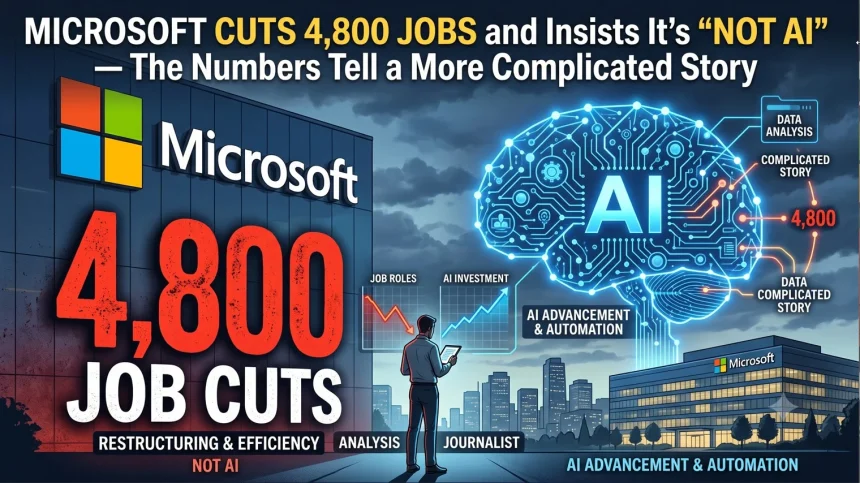
Microsoft layoffs 2026 have become one of the most discussed business stories in the technology world because they connect three major topics at the same time: job cuts, artificial intelligence, and the future of work. According to reports, Microsoft is cutting around 4,800 roles, which is about 2.1% of its global workforce. The move is part of a larger restructuring plan designed to align the company’s people, investments, and energy with its changing business priorities. The cuts are expected to affect major parts of the company, including Xbox and Microsoft’s Commercial business. est question many people are asking is simple: is AI replacing Microsoft employees? Microsoft’s Chief People Officer Amy Coleman has said that the eliminated roles are not being directly replaced by AI. That statement matters because many workers across the world are worried that artificial intelligence will silently take over human jobs. However, the full picture is more complex. AI may not be the direct reason for every job cut, but it is clearly changing how companies work, how teams are built, and what skills are becoming more valuable. Happened at Microsoft?
Microsoft has announced a fresh round of layoffs affecting around 4,800 employees. The company says this step is part of a restructuring effort that will help it focus more strongly on long-term business priorities. These job cuts are not happening in isolation. They are coming at a time when Microsoft, like many other large technology companies, is investing heavily in artificial intelligence, cloud services, enterprise tools, gaming, and customer-focused digital transformation.
The reported cuts are spread across different areas, but Xbox and Commercial teams appear to be among the most affected. Around 3,200 roles are reportedly being cut in the Xbox gaming division, while Microsoft’s Commercial business is also seeing changes as the company adjusts how it works with customers. oyees, this is a difficult moment. Layoffs are never just numbers on a business page. Every role represents a person, a family, a career path, and years of contribution. Coleman acknowledged that the affected employees are colleagues and friends who have contributed meaningfully to Microsoft. The company also said it has tried to reduce the need for job eliminations by redeploying employees into other roles where possible. icrosoft Says This Is Not About AI Replacing Jobs
The headline that attracted the most attention was Coleman’s message that the job cuts are not about AI directly replacing people. This is important because many readers quickly connect any tech layoff with artificial intelligence. The fear is understandable. AI tools can write, code, analyse data, automate support tasks, create reports, and improve productivity. Because of this, workers naturally wonder whether companies are using AI to reduce human headcount.
Microsoft’s message is more careful. The company is saying that these specific roles are not being removed because an AI tool is taking the exact same seat. At the same time, Microsoft also accepts that AI is changing how work gets done. Some daily tasks can now be automated, and employees need to keep learning new skills as work evolves. ns the real story is not “AI replaced workers overnight.” The real story is that AI is changing business priorities. When technology changes how work is done, companies rethink which roles are most useful, which departments need more investment, and which activities no longer fit their future plans.
The Bigger Reason Behind Microsoft’s Restructuring
Microsoft says the restructuring is about aligning resources with future priorities. In simple words, the company wants to move people, money, and energy toward the areas where it sees the strongest long-term growth. This includes AI, cloud, enterprise technology, customer deployment, and high-value products.
This is a common pattern in large technology companies. When a company grows quickly, it often builds many teams, products, and processes. Over time, some areas become more important while others become less central. A restructuring allows the company to reduce complexity, remove overlapping roles, and shift investment to higher-priority areas.
Microsoft has also been building new AI-focused business efforts. Its official Frontier Company page describes a model where engineering experts work directly inside customer environments to co-design and improve AI systems at scale. This shows that Microsoft is not only selling AI tools; it is also trying to help enterprise customers turn AI into practical business results. box Is Facing Major Changes
Xbox is one of the most visible parts of Microsoft’s business, so the gaming-related cuts have attracted huge attention. Microsoft has invested heavily in gaming over the years, including its acquisition of Activision Blizzard. However, gaming is a tough market. Competition from Sony PlayStation, Nintendo, mobile gaming, cloud gaming, and subscription-based platforms has made the industry more complex. say that Xbox is seeing around 3,200 job cuts as part of the broader restructuring. Microsoft is also changing how its gaming business is positioned for long-term success. This suggests that the company is trying to focus on the projects, studios, and platforms that can create stronger future value. rs, this raises questions about upcoming titles, studio operations, Game Pass strategy, and Microsoft’s future gaming direction. For workers in gaming, it reflects a larger industry problem. The gaming business has seen rising development costs, longer production cycles, changing consumer habits, and pressure to deliver bigger returns.
What the Commercial Business Shift Means
Microsoft’s Commercial business is also going through change. This part of the company works closely with enterprise customers, cloud solutions, productivity tools, and business technology deployments. As customers demand faster AI adoption and measurable results, Microsoft is changing how it supports those customers.
The company’s Frontier Company direction is a good example. Instead of only offering software and expecting customers to figure everything out alone, Microsoft wants to place engineering expertise closer to customer needs. This model can help businesses move from AI experiments to real-world deployment. ft may create demand for different types of roles. Traditional sales or support jobs may become less central, while roles involving AI implementation, customer engineering, cloud architecture, cybersecurity, data strategy, and business transformation may become more important.
How AI Is Still Changing Work Inside Big Tech
Even though Microsoft says AI is not directly replacing the eliminated roles, AI is still a major force behind the changing nature of work. AI can automate repetitive tasks, speed up software development, improve customer service, analyse business data, and help teams make faster decisions. This changes what companies expect from employees.
In the past, many jobs were built around executing routine tasks. In the future, more jobs may require people to manage AI tools, check AI outputs, apply business judgment, solve complex problems, and work across technical and non-technical teams. This does not mean human work disappears. It means human work becomes different.
For professionals, the lesson is clear. Learning AI is no longer optional in many industries. Employees do not need to become AI researchers, but they do need to understand how AI tools affect their work. People who can combine human judgment with AI productivity will have stronger career opportunities.
What Employees and Job Seekers Can Learn
The Microsoft job cuts show that even large and successful companies can restructure when business priorities change. For employees, this is a reminder to keep skills fresh. The safest career path is not always staying in one role for a long time. The safer path is building flexible skills that can move across teams, companies, and industries.
Skills such as AI literacy, data analysis, cloud computing, cybersecurity, product thinking, communication, project management, and customer problem-solving are becoming more valuable. Workers should also focus on learning how to use AI tools responsibly, because many companies will expect employees to become more productive with AI support.
Job seekers should also watch where companies are investing. If a company is cutting in one area but hiring in another, that tells you where the future demand may be. In Microsoft’s case, restructuring in Commercial and Xbox does not mean the entire company is shrinking away from innovation. It means Microsoft is reallocating resources toward areas it believes will create stronger customer value and long-term growth.
What This Means for the Future of Tech Jobs
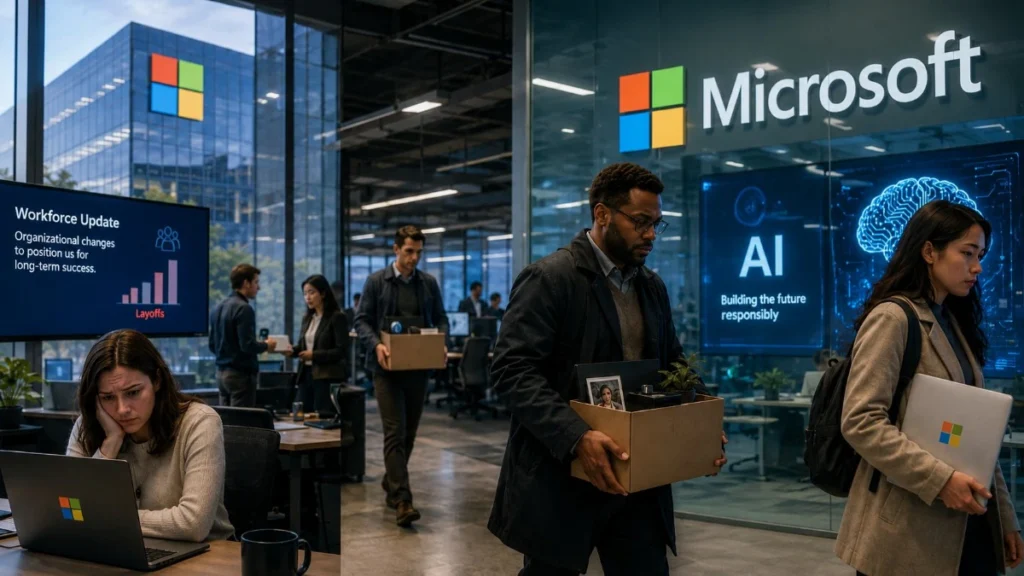
The future of tech jobs will not be shaped by AI alone. It will be shaped by a mix of AI, business strategy, customer demand, cost pressure, global competition, and changing product models. Microsoft’s layoffs are a sign that the tech industry is moving into a new stage where growth alone is not enough. Companies want efficiency, measurable outcomes, and sharper focus.
This trend may continue across the industry. Big tech companies may keep reducing roles that no longer match their future direction, while creating new roles in AI engineering, data infrastructure, cloud transformation, security, and enterprise implementation. The number of jobs may change, but the type of jobs will change even more.
For businesses, the message is to adapt early. For employees, the message is to keep learning. For investors, the message is to watch whether restructuring leads to better execution. For customers, the message is that technology companies are reorganising themselves to deliver faster, smarter, and more practical solutions.
Conclusion
Microsoft layoffs 2026 are not just about 4,800 job cuts. They are about a bigger transformation happening inside the technology industry. Microsoft says the roles are not being directly replaced by AI, but the company also admits that AI is changing how work is done. That difference is important.
The future of work is not simply humans versus machines. It is about how companies use technology, where they invest, and which skills become more valuable. Microsoft’s restructuring shows that even the biggest tech companies must keep changing to stay competitive. For employees and job seekers, the best response is not fear. The best response is preparation, learning, and building skills that remain useful in an AI-driven world.
In the coming years, the strongest professionals will be those who can combine human creativity, clear thinking, technical awareness, and AI-powered productivity. Microsoft’s latest layoffs may be difficult news, but they also offer an important signal about where the future of work is heading.