


Short overview
The Ramayana controversy 2026 began after Shri Ramlila Mahasangh requested a special screening of Nitesh Tiwari’s film before its theatrical release. The organisation also questioned Ranbir Kapoor’s portrayal of Lord Ram and warned that protests could take place if its request was ignored.
This article explains the screening demand, the criticism surrounding Ranbir Kapoor, the connection with Adipurush, the filmmakers’ stated vision and what the debate could mean for the highly anticipated Diwali release.
The debate around Nitesh Tiwari’s Ramayana has become one of the biggest Bollywood conversations ahead of Diwali 2026. Shri Ramlila Mahasangh has asked the makers to arrange a special pre-release screening for representatives of Ramlila committees and Hindu organisations. The group says it wants to identify any scenes or dialogues that may hurt religious sentiments before the film reaches theatres.
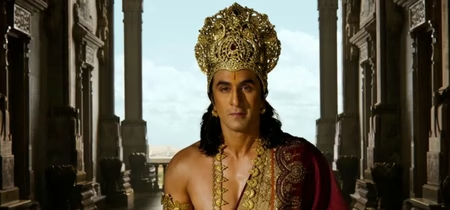
Its president, Arjun Kumar, has also criticised Ranbir Kapoor’s appearance and performance as Lord Ram based on the trailer. He described the portrayal as weak and short of the gravitas he believes is associated with the character. The organisation has warned that protests could follow if the requested screening is not arranged.
The request has quickly attracted attention because Ramayana is not an ordinary entertainment property. For millions of people, the epic is connected with faith, family traditions, festivals, moral teachings and childhood memories. Any new screen adaptation therefore arrives with unusually high expectations.
Viewers may admire cinematic scale, music and modern visual effects, but many also expect the characters, language and spiritual tone to feel respectful. The production team itself has described the story as a cultural legacy that continues to shape everyday values and traditions.
What did Shri Ramlila Mahasangh demand?
According to reports, Arjun Kumar sent a formal letter to director Nitesh Tiwari and the production team. The letter asks the filmmakers to organise a private screening before the movie’s worldwide theatrical release.
The proposed audience would include representatives of Shri Ramlila Mahasangh, Ramlila committees and Hindu organisations in Delhi. The group wants an opportunity to raise concerns in advance and request corrections if it believes that any part of the film is inaccurate or insensitive.
The organisation has also warned that demonstrations could be held outside cinemas if the makers reject or ignore its request. That warning has made the matter more serious than a normal discussion about casting or trailer quality. It has moved the conversation from social-media reactions to a possible public dispute around the film’s release.
At the same time, the Mahasangh has acknowledged that it is not the legal film-certification authority. In India, that responsibility belongs to the Central Board of Film Certification, commonly known as the CBFC.
The CBFC is a statutory body under the Ministry of Information and Broadcasting. Films must be certified by the board before they can be publicly exhibited in India. A screening requested by a cultural organisation would therefore be separate from the country’s official certification process.
Why is Adipurush part of the Ramayana controversy?
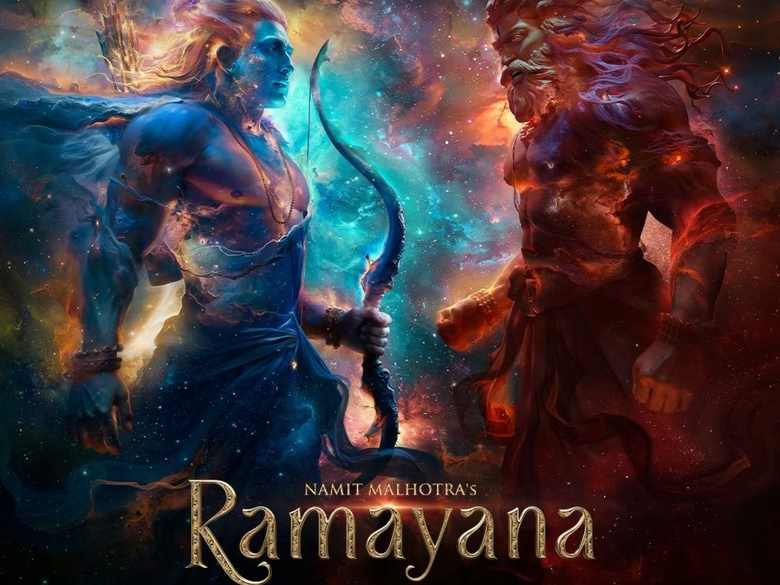
The Mahasangh’s demand is strongly connected to the controversy that followed Adipurush. Arjun Kumar referred to that film while explaining why the organisation wants to see Ramayana before its release.
He said members had objected to several creative choices in Adipurush, including its visual treatment, costumes, dialogue and the presentation of Lanka and important characters. The organisation believes that a preview could help prevent a similar situation from developing around the new movie.
That earlier experience appears to have created a trust gap. From the group’s point of view, promotional material may not reveal every element that could become controversial after a movie arrives in theatres. It therefore wants to see the completed film rather than relying only on posters, teasers and trailers.
The comparison also places additional pressure on Nitesh Tiwari’s production. Although this Ramayana has a different creative team, cast and visual approach, many viewers will judge it against the lessons learned from earlier mythological adaptations.
The filmmakers must balance devotion, dramatic storytelling, cultural interpretation and modern spectacle without allowing one element to overpower the others. A visually impressive film may still disappoint audiences if its emotional tone does not feel sincere. In the same way, a respectful adaptation must also work as engaging cinema for viewers who are discovering the epic for the first time.
Why did the group criticise Ranbir Kapoor as Lord Ram?
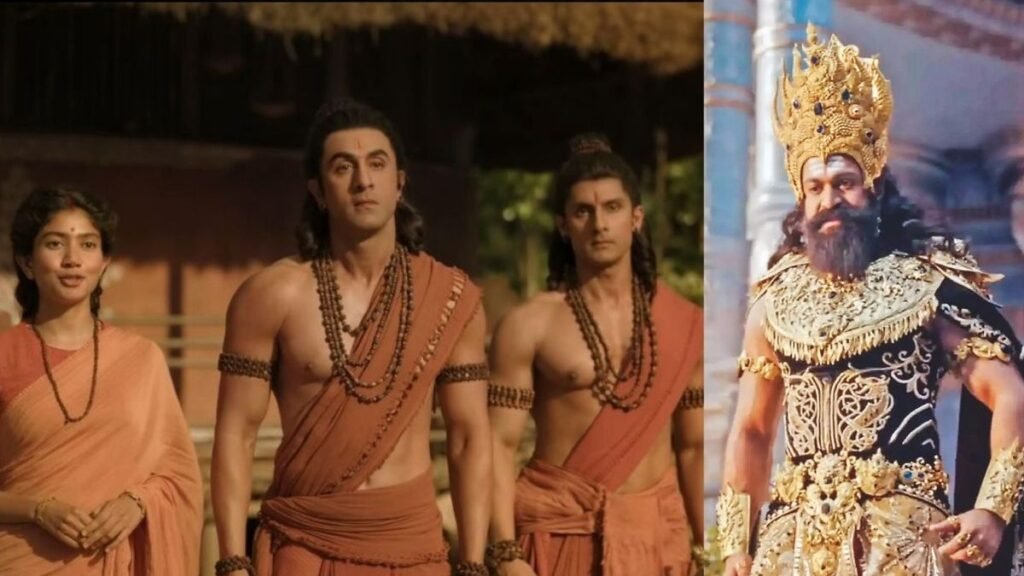
The most discussed part of the Mahasangh’s statement concerns Ranbir Kapoor’s portrayal of Lord Ram. Based on the released trailer, the organisation’s president said that the performance appeared underwhelming and did not fully carry the dignity or authority he expected from the character.
This remains an opinion rather than an established fact. A trailer presents carefully selected moments and cannot show the full emotional journey of a performance.
Some viewers may agree with the criticism, while others may find Ranbir Kapoor calm, sincere and suitable for the role. A meaningful judgement will become possible only after audiences see the complete film and understand how the character develops within the story.
The debate reveals how difficult it is for a well-known actor to play a deeply revered figure. Audiences do not approach such a performance only as cinema. They bring personal beliefs, traditional imagery, television memories and individual ideas about how Lord Ram should speak, move and express emotion.
An actor’s previous roles and public image can also influence expectations before the film begins. This does not automatically make a famous performer right or wrong for the part, but it means the performance is likely to face closer examination than an ordinary fictional role.
What have the filmmakers said about their approach?
At the time of writing on 4 August 2026, no direct public response from the filmmakers to this specific screening demand was visible in the official statements and reports reviewed. This is an observation based on the available sources and may change if the production team releases a new statement.
However, the production team has repeatedly spoken about responsibility, emotional truth and cultural respect in its earlier official communication.
Prime Focus describes Ramayana as a two-part live-action epic produced by Prime Focus Studios in association with DNEG and Monster Mind Creations. The project has been designed for worldwide audiences and filmed for IMAX.
Official information confirms Ranbir Kapoor as Rama, Sai Pallavi as Sita, Yash as Ravana, Sunny Deol as Hanuman and Ravie Dubey as Lakshman.
Director Nitesh Tiwari has said that the story’s emotional strength comes from choices, consequences and the difficulty of doing what is right. Ranbir Kapoor has described playing Rama as a humbling experience and said that he approached the part as an opportunity to learn from the character rather than simply represent him.
These comments suggest that the creative team wants the film to focus on inner values as much as visual grandeur. Whether the final result achieves that goal will be decided by audiences after release.
The official promotional campaign also highlights the enormous scale of the production. Prime Focus says the trailer was released in five Indian languages. Sony Pictures is handling distribution in international markets, while Dharma Productions is responsible for North India’s Hindi-speaking markets.
The music brings together A. R. Rahman and Hans Zimmer, making the soundtrack another major point of interest for Indian and international audiences.
Can a pre-release screening solve the problem?
A special screening could create a channel of communication between filmmakers and community representatives. If both sides participate in good faith, it may help clarify concerns, correct misunderstandings and reduce tension before release.
Consultation can be valuable when a film deals with a living religious tradition that carries deep emotional importance. It may also allow the production team to explain the research, symbolism and creative reasoning behind particular scenes.
However, a private screening would also raise difficult questions. The Ramayana has many regional versions, performance traditions and interpretations. No single organisation can speak for every believer, scholar, artist or audience member.
A change requested by one group may not satisfy another. Filmmakers also have creative rights, while audiences have the right to examine and criticise the finished work.
The most constructive path would involve respectful communication without threats, personal attacks or rushed conclusions. Cultural representatives could identify specific concerns rather than making broad accusations. The filmmakers could explain how they approached sensitive material and which sources guided their adaptation.
Audiences should also be encouraged to judge the complete story instead of reaching a permanent conclusion from a few seconds of promotional footage.
What the controversy means for the film’s release
The controversy is likely to increase curiosity around Ramayana: Part One. Search interest related to the trailer, cast, release date and Ranbir Kapoor’s Lord Ram appearance may grow as more people join the conversation.
That attention can improve online visibility, but it also creates risk. Every new promotional image, song and interview will be examined for costume details, dialogue, visual symbolism and characterisation.
The movie has been planned as the first chapter of a two-part franchise. Official announcements place Part One in 2026 and Part Two in 2027, while entertainment reports identify Diwali as the planned release period for both chapters.
Because the story is being positioned for international audiences, the filmmakers must communicate with two broad groups. The first includes viewers who know the epic deeply and have strong emotional expectations. The second includes people who may be experiencing the story for the first time through this film.
The strongest marketing strategy will not be controversy alone. Long-term audience trust will depend on storytelling, performances, music, visual effects and respect for the source tradition.
A large budget, global distribution and famous cast can create anticipation. Emotional authenticity will ultimately determine whether viewers connect with the film.
A balanced view of the Ramayana debate
It is reasonable for cultural organisations to express concerns about the portrayal of sacred figures. It is also reasonable for filmmakers to ask audiences to judge a complete work instead of a short trailer. Both ideas can exist together.
Calling a performance weak before release may generate headlines, but it does not settle the question. Similarly, impressive visual effects and ambitious promotional claims do not guarantee that the final movie will satisfy viewers.
The responsible approach is to separate verified facts from personal opinion.
The verified facts are that Shri Ramlila Mahasangh has requested a special pre-release screening, criticised Ranbir Kapoor’s portrayal based on the trailer and warned of protests if the request is not accepted. The filmmakers have publicly emphasised responsibility, global scale and emotional depth, but a direct response to the latest demand had not been identified at the time of writing.
Conclusion
The Ramayana controversy 2026 shows how strongly audiences care about the way India’s sacred stories are adapted for cinema. Shri Ramlila Mahasangh wants a special preview because it fears a repeat of the objections raised during Adipurush.
Its criticism of Ranbir Kapoor has intensified the debate, but a trailer alone cannot provide a final verdict on his performance.
Nitesh Tiwari’s film now carries two major responsibilities. It must deliver a powerful cinematic experience, and it must handle a revered cultural narrative with sensitivity.
Open communication, careful certification and a willingness to listen could reduce conflict before release. Ultimately, audiences will decide whether Ramayana succeeds by watching the full film and judging its sincerity, storytelling and emotional impact.