



Short Overview
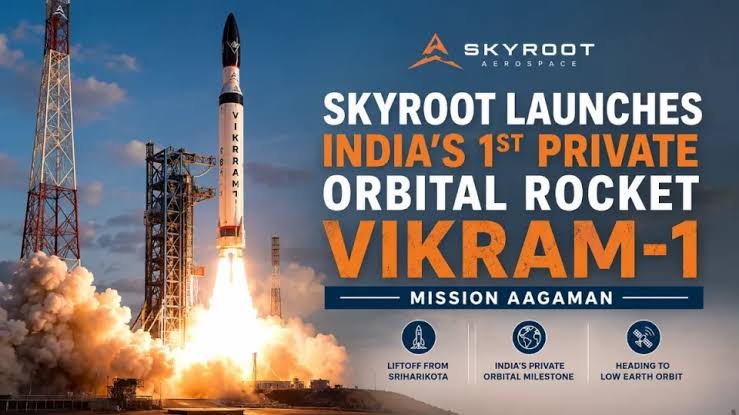
India has entered a new chapter in commercial spaceflight after Skyroot Aerospace successfully sent its Vikram-1 rocket into low-Earth orbit. The mission, called Aagaman, is important because it shows that a privately developed Indian launch vehicle can move beyond testing and complete an orbital mission. It also gives satellite companies a new reason to consider India for flexible, dedicated and faster launch services.
Discover how the Skyroot Aerospace Vikram-1 launch changed India’s private space sector forever. This detailed guide explains Mission Aagaman, Vikram-1 technology, payload capacity, launch achievements, ISRO and IN-SPACe support, commercial opportunities, and the future of India’s space startups in simple language. Learn why reaching low-Earth orbit on the maiden flight matters, how Vikram-1 differs from Vikram-S, and what this milestone means for small satellite companies, investors, engineers, and global launch customers. Explore the challenges Skyroot must overcome next as India builds a stronger, faster, and more competitive private space economy for the world in the coming decade and beyond today.
India’s New Private Space Milestone
India’s space story has always been built on patience, scientific discipline and ambitious goals. For decades, the Indian Space Research Organisation has carried the nation’s satellites, research missions and global reputation into space. On July 18, 2026, that story gained a powerful new chapter when Skyroot Aerospace’s Vikram-1 completed its maiden orbital flight from the Satish Dhawan Space Centre in Sriharikota.
July 18 also carries special meaning in Indian space history. On the same date in 1980, the SLV-3 successfully placed the Rohini satellite into orbit, helping establish India as a spacefaring nation. Forty-six years later, Vikram-1 used the same calendar date to mark another transition: from a national programme proving India could reach orbit to a private Indian company proving it could build and fly an orbital launcher.
The successful Skyroot Aerospace Vikram-1 launch was more than a single rocket leaving the ground. It represented the arrival of a new kind of Indian space company: one that can design a launch vehicle, work through demanding testing and regulatory processes, coordinate with national institutions and finally place payloads into orbit.
For ordinary readers, the importance can be explained simply. Reaching space and reaching orbit are not the same achievement. A rocket may cross the accepted boundary of space and still fall back to Earth. To enter orbit, it must gain enough speed, follow an extremely accurate path and release its payload at the correct altitude and direction. Vikram-1 achieved that difficult goal on its first orbital attempt.
What Happened During Mission Aagaman?
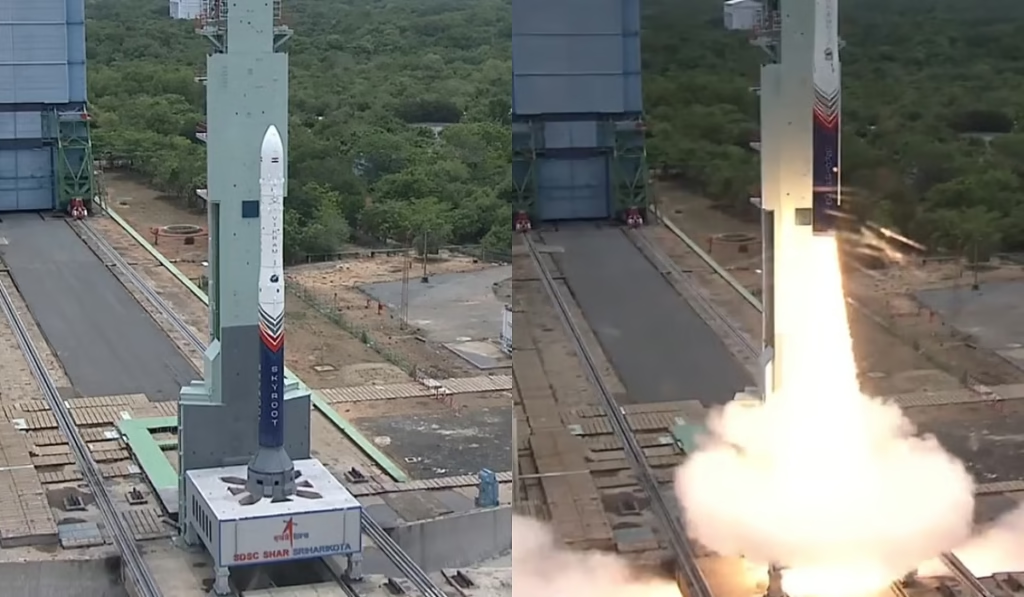
Mission Aagaman lifted off from the First Launch Pad at Sriharikota and carried satellites and technology-demonstration payloads into an orbit of about 450 kilometres. The mission included Skyroot’s SCOPE satellite and Grahaa Space’s Solaras satellite, along with experiments from other technology companies. The flight tested the rocket under real operating conditions, including propulsion, guidance, navigation, stage separation, telemetry and payload deployment.
The mission immediately placed Skyroot in a small international group of private companies that have developed and flown an orbital-class rocket. For India, it also marked the first successful orbital mission by a privately developed Indian launch vehicle from Indian soil. ISRO listed the event among its latest achievements as the first private orbital launch from Sriharikota.
That distinction matters. The launch was not simply a government rocket carrying a private payload. Vikram-1 was created as a commercial launch system by an Indian startup. Its success shows that India’s private space reforms are beginning to produce working hardware, skilled teams and real launch capability.
Why Reaching Orbit on the First Flight Matters
A first flight is one of the hardest moments in any rocket programme. Engineers can run computer simulations, test engines, inspect materials and repeat ground trials, but a full launch brings every system together in a harsh environment. The rocket must survive intense vibration, heat, pressure and acceleration while making rapid decisions through its onboard computers.
Every stage must fire at the right time. Each separation event must happen cleanly. The navigation system must continuously understand the vehicle’s position. Communication links must send useful data back to mission control. Even a small error can prevent a rocket from reaching its planned orbit.
This is why Vikram-1 reaching orbit on its maiden flight is such a meaningful engineering result. It does not prove that every future launch will succeed, but it confirms that the main design can work as an integrated system. It also gives Skyroot a large amount of real flight data that cannot be fully recreated on the ground.
The flight data will help engineers identify how the vehicle behaved during every stage of the mission. Skyroot can use these findings to improve manufacturing, software, propulsion performance, separation systems and mission planning before routine commercial launches begin.
From Vikram-S to Vikram-1
Vikram-1 did not appear suddenly. Skyroot’s journey reached public attention in November 2022 with Mission Prarambh, when the smaller Vikram-S vehicle completed a suborbital flight from Sriharikota. That mission made Skyroot the first private Indian company to launch a rocket into space. ISRO reported that Vikram-S reached an altitude of approximately 89.5 kilometres during the mission.
Vikram-S was designed to validate important technologies, including solid propulsion, carbon-composite structures, avionics and telemetry. It was a stepping stone rather than a commercial orbital launcher. Vikram-1 is a much more complex vehicle because it must create and control the speed needed to keep payloads moving around Earth.
The progress from Vikram-S to Vikram-1 reflects a sensible development strategy. Instead of attempting every challenge in one mission, the company first tested selected systems, improved its manufacturing and completed larger ground trials.
One major test took place in August 2025, when the Kalam-1200 first-stage solid motor was successfully tested at Sriharikota. ISRO described the test as an important milestone in the development of Vikram-1.
The successful orbital flight is therefore the result of several years of engineering, manufacturing and testing rather than a single dramatic launch day.
Understanding Vikram-1’s Technology
Vikram-1 is designed for the growing small-satellite market. According to Skyroot, the vehicle can carry up to 350 kilograms to low-Earth orbit and up to 260 kilograms to a sun-synchronous orbit. These orbits are widely used for Earth observation, mapping, climate monitoring, communications, scientific research and security-related applications.
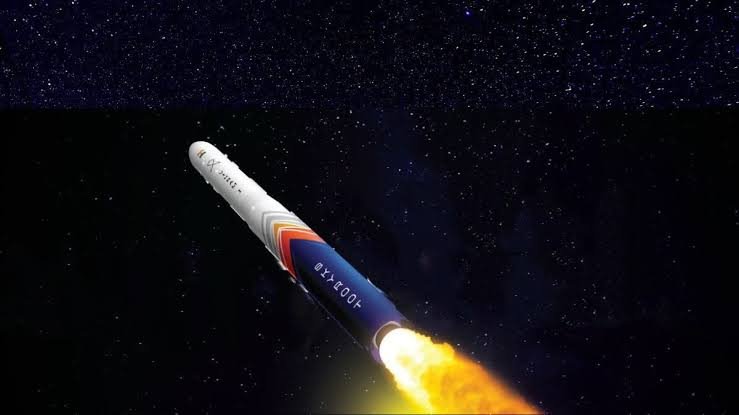
The rocket uses a four-stage design. Its first three stages use solid propulsion, which is valued for structural simplicity and the ability to store propellant for long periods. The upper stage uses liquid propulsion, giving the mission greater control when adjusting the final orbit and deploying payloads.
Skyroot also highlights the use of carbon-composite structures, a 3D-printed liquid engine and systems designed to reduce shock during separation. These features are valuable because small satellites can be sensitive to vibration. A launch provider must not only reach orbit; it must protect the customer’s spacecraft during the journey.
Another important feature is flexibility. Large rockets are highly efficient when many satellites share one mission, but smaller customers may have to wait for a suitable rideshare opportunity. A dedicated small launcher can offer more control over the launch date, orbital path and deployment plan.
This can be especially useful for a company that needs a satellite placed in a specific orbit at a specific time. Earth-observation companies, for example, may need a particular orbital inclination to provide useful imagery of selected regions. Communications or research missions may also require carefully planned deployment conditions.
How ISRO and IN-SPACe Supported the Mission
Skyroot is a private company, but Vikram-1’s success also demonstrates the value of cooperation between public institutions and private industry. ISRO supported the programme with access to specialised facilities, technical knowledge and testing infrastructure.
The first-stage motor was cast and tested at Sriharikota, while other propulsion and vehicle systems were also validated using national facilities. ISRO supported testing, trajectory work, stage preparation, vehicle integration and launch-site operations.
IN-SPACe played a central role by helping the company access infrastructure, coordinating reviews and supporting the authorisation process. This model allows startups to build commercial products without having to recreate every expensive national facility from the beginning.
The relationship is not about replacing ISRO. It is about expanding India’s total space capacity. Private launch companies can focus on commercial customers, responsive missions and specialised services. ISRO can continue to lead national science missions, human spaceflight, planetary exploration and complex technology programmes.
This division of effort may help India launch more often and serve a wider variety of customers. It can also make the national space ecosystem more resilient by creating multiple teams, suppliers and launch options.
Opportunities in the Small-Satellite Launch Market
The number of small satellites used for Earth observation, communications, navigation, scientific research, climate analysis and security applications has created demand for more launch choices.
Many small satellites currently travel as secondary payloads on larger rockets. This approach can reduce costs, but customers may have limited control over the date, orbit and deployment sequence.
A dedicated small-satellite launch vehicle such as Vikram-1 offers a different service. It can potentially provide a mission designed around the customer’s satellite rather than asking the customer to adapt to a larger launch schedule.
For satellite businesses, an Indian private launch option could mean shorter planning cycles and more choice. Earth-observation startups, communications companies, universities and technology demonstrators often operate small spacecraft. They may value schedule control and direct orbital access as much as the lowest possible price per kilogram.
Vikram-1 could also serve customers that need to replace a satellite quickly. Responsive access to orbit is becoming important for disaster monitoring, maritime awareness, communications and strategic applications.
Economic Benefits for India
The successful Vikram-1 rocket launch could have an impact far beyond Skyroot’s own business. Rockets depend on a deep supply chain that includes advanced materials, electronics, sensors, software, precision manufacturing, testing equipment and specialised engineering services.
The reference report states that close to 400 suppliers contributed to the wider effort. That scale shows how one launch programme can create opportunities for manufacturers and technical companies across India. As launch frequency grows, suppliers gain more experience, improve quality and become better prepared to compete for international work.
The mission may also encourage more investment in Indian space startups. Investors understand that rocket development is expensive and risky. A successful orbital flight reduces some technical uncertainty because the company has demonstrated that its system can work in the real world.
India’s broader opportunity is significant. The country has strong engineering talent, a respected national space programme, a growing startup network and comparatively competitive operating costs. If private launch providers become reliable, India could capture more international business in satellite launches, spacecraft manufacturing, data services and ground systems.
The benefits may also reach educational institutions. A growing private space industry can create opportunities for students and professionals in aerospace engineering, electronics, artificial intelligence, advanced manufacturing, materials science, software and satellite data analysis.
Challenges Skyroot Must Address
One successful mission is the beginning of a commercial journey, not the end. Customers will now watch how consistently Skyroot can repeat the result. Reliability is built through multiple flights, transparent performance and the ability to deliver payloads to the promised orbit on schedule.
Launch frequency will also matter. A company may have an excellent rocket, but customers need confidence that missions will be available when required. Building vehicles regularly, maintaining quality and securing launch windows are major operational challenges.
Price competition is another reality. Large reusable rockets can carry many satellites at once and offer low rideshare prices. Vikram-1 may not always compete by offering the cheapest cost per kilogram. Its stronger selling points may be dedicated missions, flexible scheduling, faster integration and customised orbital deployment.
Skyroot will also need a steady order book. Rocket development requires large investments, skilled teams and continuous testing. Commercial sustainability depends on signing customers, managing costs and improving the vehicle after every flight.
What Comes After Vikram-1?
The most encouraging point is that India’s private launch conversation has changed. Earlier, the question was whether an Indian startup could build an orbital rocket at all. After Mission Aagaman, the questions are about reliability, scale, customer demand and future vehicles.
Skyroot has already described Vikram-1 as part of a wider family of launch systems. Its official roadmap includes Vikram-II, a larger vehicle intended to carry heavier payloads and provide greater orbital flexibility. Skyroot currently lists Vikram-II for a planned 2027 introduction.
The company has also discussed long-term reusable launch technology, although such systems will require further development and testing.
For India, the next stage will involve more launches from multiple private companies, stronger satellite businesses and deeper cooperation between industry, universities, investors, ISRO and IN-SPACe. The success of one company can create confidence, but a strong national space economy requires many capable participants.
Conclusion
Vikram-1’s maiden orbital success is a historic milestone because it turns India’s private space ambition into a visible result. The rocket carried more than payloads into low-Earth orbit; it carried the hopes of engineers, entrepreneurs, suppliers and young people who want to build the next generation of space technology in India.
The achievement should be celebrated without ignoring the work ahead. Skyroot must now prove that it can launch safely, repeatedly and commercially. It will need to improve reliability, increase launch frequency, attract international customers and compete with established launch providers.
If the company succeeds, Vikram-1 could become more than India’s first private orbital rocket. It could become a foundation for faster satellite access, new high-skill jobs and a stronger Indian position in the global space economy.
Mission Aagaman means arrival, and the name now feels appropriate. India’s private launch industry has not reached its final destination, but it has clearly arrived at the starting point of a much larger journey.