



The Tamil Nadu reservation case has created a major legal discussion across India. At the centre of the issue is one important question: can a person who converts to Islam claim Backward Class Muslim reservation benefits if they earlier belonged to a Backward Class, Most Backward Class, Denotified Community, or Scheduled Caste background?
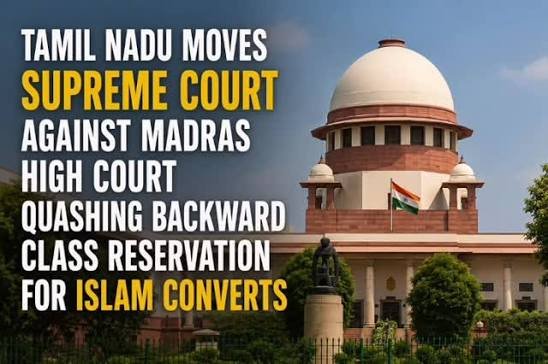
This question is now before the Supreme Court because the Tamil Nadu government has challenged a Madras High Court judgment. The High Court had struck down a 2024 Government Order that allowed certain people who converted to Islam to be treated as Backward Class Muslims for reservation benefits. The State has now filed a Special Leave Petition before the Supreme Court.
This case is not only about one community certificate. It is also about reservation policy, religious conversion, constitutional law, social justice, and the power of a state government to issue executive orders. For many readers, the legal language around this case may sound difficult. This article explains the full issue in simple and clear words.
What Is the Tamil Nadu Reservation Case?
The case started when a person named Sameer Ahamed sought a community certificate identifying him as belonging to the “Muslim Lebbai” community. According to reports, he had converted to Islam in 2015 and later applied for a community certificate. His application was rejected by the local revenue authority, and he approached the Madras High Court.
While the case was pending, the Tamil Nadu government issued a Government Order on March 9, 2024. This order allowed people who had earlier belonged to Backward Classes, Most Backward Classes, Denotified Communities, or Scheduled Castes to be treated as Backward Class Muslims after converting to Islam, if they were accepted into one of the notified Muslim groups.
The High Court examined the Government Order and found it legally problematic. The court declared the order unconstitutional and held that a person converting to Islam could not automatically claim Backward Class Muslim status for reservation benefits.
Background of the Dispute
Tamil Nadu has a long history of reservation policies for socially and educationally backward communities. In the state’s reservation framework, certain Muslim communities are notified as Backward Class Muslims. These include communities such as Ansar, Dekkani Muslims, Dubekula, Labbais including Rowthar and Marakayar, Mapilla, Sheik, and Syed.
The dispute arose because the petitioner wanted recognition as a member of one of these notified groups after conversion. The issue was whether religious conversion alone, or acceptance by a religious/community body, could allow a person to receive a community certificate under a notified Backward Class Muslim category.
The petitioner’s side relied on the 2024 Government Order. The State argued that the order was issued after deliberation and was meant to ensure that people who already had reservation benefits before conversion would not lose them only because they changed their religion.
In simple terms, Tamil Nadu’s argument was based on continuity of social disadvantage. The State’s position was that if a person belonged to a socially backward group before conversion, their social and educational disadvantages may not disappear immediately after conversion.
What the 2024 Government Order Said
The 2024 Tamil Nadu Government Order allowed certain converts to Islam to be treated as Backward Class Muslims. It applied to people who came from BC, MBC, DNC, or SC backgrounds and converted to Islam. The order allowed such persons to be issued community certificates as belonging to one of the seven notified Backward Class Muslim groups.
The State reportedly argued that the Tamil Nadu Backward Classes Commission had recommended this approach. The purpose, according to the State, was not to create a new reservation category but to prevent people from losing existing benefits because of conversion.
This is why the case became important. It raised a difficult question: should reservation benefits follow a person’s social background, or should they depend only on the community status legally recognised after conversion?
Why the Madras High Court Quashed the Order
The Madras High Court took a different view from the State. The court held that conversion to Islam does not automatically make a person a member of a notified Backward Class Muslim community. According to the court, when a person converts to Islam, they become Muslim, but they do not automatically become Labbai, Rowther, Marakayar, Dekkani Muslim, or any other birth-based notified community.
The High Court also relied on earlier judicial precedents. Hindustan Times reported that the court referred to a 1951 Madras High Court ruling in G. Michael v. S. Venkateswaran, where it was held that a Hindu converting to Islam becomes “just a Mussalman” and does not automatically acquire membership of a specific Muslim community.
The court also said that the executive branch cannot override settled judicial decisions through a Government Order. In other words, if a legal principle has already been settled by courts, the government cannot simply issue an administrative order to create the opposite legal effect.
This was one of the main reasons the High Court declared the 2024 order unconstitutional. The court believed that if the government wanted to change the legal position, it should do so through proper legislation, not through an executive order.
Why Tamil Nadu Moved the Supreme Court
After the High Court judgment, Tamil Nadu approached the Supreme Court. According to LiveLaw, the State filed a Special Leave Petition on July 6, 2026, challenging the Madras High Court decision. The case is listed as The Secretary to Government v. Sameer Ahamed, Diary No. 39624/2026.
The Supreme Court will now have to consider whether the High Court was correct in striking down the Government Order. It may also examine whether a state can protect reservation benefits for people who convert from already backward communities to Islam.
This makes the case important because the Supreme Court’s view could influence how states handle reservation benefits after religious conversion. It could also bring more clarity to the relationship between caste-based disadvantage, religious identity, and notified backward class categories.
Why This Case Matters for Reservation Policy
This case matters because reservation in India is not only a legal subject. It is also closely connected to social justice, historical disadvantage, education, employment, and political representation.
Supporters of Tamil Nadu’s position may argue that social backwardness does not disappear overnight after a person changes religion. They may say that if a person was disadvantaged before conversion, the person may continue to face social and economic barriers even after conversion.
On the other hand, the High Court’s reasoning focuses on legal recognition of specific communities. According to this view, reservation benefits cannot be granted only on the basis of conversion. The person must legally belong to a recognised backward class community.
This is why the matter is complex. It involves two different concerns. One concern is social justice for historically disadvantaged people. The other concern is the legal structure of reservation categories.
What Could Happen Next?
The Supreme Court may admit the matter and hear arguments from Tamil Nadu and the respondents. It may examine the constitutional validity of the 2024 Government Order, the earlier judicial precedents, and the role of state policy in identifying backward classes.
The court may also consider whether executive orders can protect reservation benefits after conversion, or whether such changes require legislation. The outcome could have a wider impact on future cases involving religious conversion and community certificates.
Until the Supreme Court gives its decision, the Madras High Court judgment remains a major legal development. However, the final position may become clearer only after the Supreme Court examines the matter.
Conclusion
The Tamil Nadu reservation case is important because it deals with a sensitive and complicated question: what happens to reservation benefits when a person converts to another religion?
The Madras High Court held that a person converting to Islam cannot automatically claim Backward Class Muslim status. It also struck down the 2024 Tamil Nadu Government Order that allowed certain converts to be treated as members of notified Backward Class Muslim communities. Tamil Nadu has now challenged this decision before the Supreme Court.
The case is not just about one person or one certificate. It is about how India balances religious freedom, caste-based disadvantage, social justice, and constitutional limits on government power. The Supreme Court’s decision may become an important guide for future debates on reservation benefits after religious conversion.
For now, this case remains one of the most closely watched legal developments in India’s reservation policy debate.